 Add to Chrome
 Add to Firefox
 Add to Edge
Plan Before Search: Search Agents Need Plan
May 27, 2026
Training large language models as retrieval-augmented reasoning agents typically combines reinforcement learning with an SFT cold start distilled from a stronger model. However, this paradigm overlooks two fundamental factors: the dependency structure among sub-skills, and the possibility that distillation is not the only route to capability acquisition. We study this through Plan, a structured agentic behavior for multi-hop retrieval that decomposes a question into ordered sub-questions before any retrieval is performed, so that each search step can be anchored to a pre-designed sub-question instead of drifting under the influence of partially relevant documents retrieved earlier. However, across three model families spanning 3B to 14B parameters, we find that an identical reward signal induces qualitatively different RL failure modes. This phenomenon indicates that successful training hinges not only on reward design but also on model-specific feasibility conditions: sufficient initial entropy, training stability, and prerequisite sub-skills. Motivated by this, we propose a self-bootstrapping paradigm in which a small-scale seed model generates filtered trajectories that activate Plan in any target model, eliminating the need for distillation from an external stronger model. Our pipeline activates Plan across every tested model and consistently outperforms competitive baselines on multi-hop QA benchmarks.

Search-E1: Self-Distillation Drives Self-Evolution in Search-Augmented Reasoning
May 21, 2026Post-training has become the dominant recipe for turning a language model into a competent search-augmented reasoning agent. A line of recent work pushes its performance further by adding elaborate machinery on top of this standard pipeline. These augmentations import external supervision from stronger external systems, attach auxiliary modules such as process reward models or retrospective critics, restructure the rollout itself with tree search or multi-stage curricula, or shape the reward with hand-crafted bonuses and penalties. Each addition delivers a measurable gain, but each also inflates the training pipeline and ties the recipe to resources or designs that may not always be available. We take a step back and ask whether any of this machinery is actually necessary, and propose Search-E1, a self-evolution method that lets a search-augmented agent improve through only vanilla GRPO interleaved with offline self-distillation (OFSD). After each GRPO round, the policy rolls out on its own training questions. A token-level forward KL objective then aligns the policy's inference-time distribution to its own distribution under a privileged context that exposes a more efficient sibling trajectory. Despite this simplicity, the procedure naturally provides dense per-step supervision. On seven QA benchmarks, Search-E1 reaches $0.440$ average EM with Qwen2.5-3B, surpassing all open-source baselines at both scales. Code and complete version will be made public soon.
SD-Search: On-Policy Hindsight Self-Distillation for Search-Augmented Reasoning
May 18, 2026Search-augmented reasoning agents interleave internal reasoning with calls to an external retriever, and their performance relies on the quality of each issued query. However, under outcome-reward reinforcement learning, every search decision in a rollout shares the same trajectory-level reward, leaving individual queries without step-specific credit. Recent process-supervision approaches address this gap by drawing step-level signals from outside the policy, relying either on a much larger teacher model, or on sub-question annotations produced by a stronger external system. In contrast, we propose SD-Search, which derives step-level supervision from the policy itself through on-policy hindsight self-distillation, requiring neither an external teacher nor additional annotations. In SD-Search, a single model plays two roles that differ only in conditioning: a student that sees only the context available at inference time, and a teacher that additionally conditions on a compact hindsight block summarizing the search queries and final outcomes of a group of rollouts sampled from the same question. Since the teacher knows how each rollout unfolded and which ones succeeded, its query distribution implicitly marks which decisions were worth making, and the student is trained to recover this behavior by minimizing the token-level Jensen--Shannon divergence to the teacher at search-query positions. This layers a dense, step-level signal on top of GRPO's coarse trajectory reward. Crucially, this signal is produced by the policy itself within the standard RL training loop, without external model inference, auxiliary annotation pipeline, or additional training stage.
TIGER-FG: Text-Guided Implicit Fine-Grained Grounding for E-commerce Retrieval
May 18, 2026E-commerce image search often takes a cropped image as the query, while each candidate is represented by full item images and structured text. This image-to-multimodal retrieval setting presents two asymmetries: a modality disparity -- a visual query must match image--text items, and a granularity disparity -- a cropped query must be compared with full images containing background context and possible distractors. Detection-based pipelines handle the granularity disparity through explicit localization but incur extra cost and error propagation, whereas CLIP-style encoders avoid detection, but are vulnerable to backgrounds or irrelevant items. To address these limitations, we propose TIGER-FG, a text-guided implicit fine-grained grounding framework for image-to-multimodal e-commerce retrieval. TIGER-FG uses item text as semantic guidance to produce target-focused item representations without object detection for retrieval. We further introduce dual distillation objectives that preserve target-region spatial consistency and query--item similarity structure, yielding more stable and discriminative multimodal representations. In addition, we construct ECom-RF-IMMR, a realistic benchmark suite with a 10M-pair training set and two evaluation benchmarks covering standard and cluttered item layouts. TIGER-FG improves Recall@1 over the strongest baseline by 6.1 and 34.4 percentage points on the two evaluation benchmarks, respectively, with only 85.7M query-side parameters and 256-dim embeddings. Results on public e-commerce benchmarks further demonstrate its generalization to noisy and one-to-many retrieval scenarios. Code and data will be released.
CoWorld-VLA: Thinking in a Multi-Expert World Model for Autonomous Driving
May 11, 2026Vision-Language-Action (VLA) models have emerged as a promising paradigm for end-to-end autonomous driving. However, existing reasoning mechanisms still struggle to provide planning-oriented intermediate representations: textual Chain-of-Thought (CoT) fails to preserve continuous spatiotemporal structure, while latent world reasoning remains difficult to use as a direct condition for action generation. In this paper, we propose CoWorld-VLA, a multi-expert world reasoning framework for autonomous driving, where world representations serve as explicit conditions to guide action planning. CoWorld-VLA extracts complementary world information through multi-source supervision and encodes it into expert tokens within the VLA, thereby providing planner-accessible conditioning signals. Specifically, we construct four types of tokens: semantic interaction, geometric structure, dynamic evolution, and ego trajectory tokens, which respectively model interaction intent, spatial structure, future temporal dynamics, and behavioral goals. During action generation, CoWorld-VLA employs a diffusion-based hierarchical multi-expert fusion planner, which is coupled with scene context throughout the joint denoising process to generate continuous ego trajectories. Experiments show that CoWorld-VLA achieves competitive results in both future scene generation and planning on the NAVSIM v1 benchmark, demonstrating strong performance in collision avoidance and trajectory accuracy. Ablation studies further validate the complementarity of expert tokens and their effectiveness as planning conditions for action generation. Code will be available at https://github.com/potatochip1211/CoWorld-VLA.
Learning Dynamic Representations and Policies from Multimodal Clinical Time-Series with Informative Missingness
Apr 23, 2026Multimodal clinical records contain structured measurements and clinical notes recorded over time, offering rich temporal information about the evolution of patient health. Yet these observations are sparse, and whether they are recorded depends on the patient's latent condition. Observation patterns also differ across modalities, as structured measurements and clinical notes arise under distinct recording processes. While prior work has developed methods that accommodate missingness in clinical time series, how to extract and use the information carried by the observation process itself remains underexplored. We therefore propose a patient representation learning framework for multimodal clinical time series that explicitly leverages informative missingness. The framework combines (1) a multimodal encoder that captures signals from structured and textual data together with their observation patterns, (2) a Bayesian filtering module that updates a latent patient state over time from observed multimodal signals, and (3) downstream modules for offline treatment policy learning and patient outcome prediction based on the learned patient state. We evaluate the framework on ICU sepsis cohorts from MIMIC-III, MIMIC-IV, and eICU. It improves both offline treatment policy learning and adverse outcome prediction, achieving FQE 0.679 versus 0.528 for clinician behavior and AUROC 0.886 for post-72-hour mortality prediction on MIMIC-III.
IG-Search: Step-Level Information Gain Rewards for Search-Augmented Reasoning
Apr 16, 2026Reinforcement learning has emerged as an effective paradigm for training large language models to perform search-augmented reasoning. However, existing approaches rely on trajectory-level rewards that cannot distinguish precise search queries from vague or redundant ones within a rollout group, and collapse to a near-zero gradient signal whenever every sampled trajectory fails. In this paper, we propose IG-Search, a reinforcement learning framework that introduces a step-level reward based on Information Gain (IG). For each search step, IG measures how much the retrieved documents improve the model's confidence in the gold answer relative to a counterfactual baseline of random documents, thereby reflecting the effectiveness of the underlying search query. This signal is fed back to the corresponding search-query tokens via per-token advantage modulation in GRPO, enabling fine-grained, step-level credit assignment within a rollout. Unlike prior step-level methods that require either externally annotated intermediate supervision or shared environment states across trajectories, IG-Search derives its signals from the policy's own generation probabilities, requiring no intermediate annotations beyond standard question-answer pairs. Experiments on seven single-hop and multi-hop QA benchmarks demonstrate that IG-Search achieves an average EM of 0.430 with Qwen2.5-3B, outperforming the strongest trajectory-level baseline (MR-Search) by 1.6 points and the step-level method GiGPO by 0.9 points on average across benchmarks, with particularly pronounced gains on multi-hop reasoning tasks. Despite introducing a dense step-level signal, IG-Search adds only ~6.4% to per-step training wall-clock time over the trajectory-level baseline and leaves inference latency unchanged, while still providing a meaningful gradient signal even when every sampled trajectory answers incorrectly.
OneSearch-V2: The Latent Reasoning Enhanced Self-distillation Generative Search Framework
Mar 25, 2026Generative Retrieval (GR) has emerged as a promising paradigm for modern search systems. Compared to multi-stage cascaded architecture, it offers advantages such as end-to-end joint optimization and high computational efficiency. OneSearch, as a representative industrial-scale deployed generative search framework, has brought significant commercial and operational benefits. However, its inadequate understanding of complex queries, inefficient exploitation of latent user intents, and overfitting to narrow historical preferences have limited its further performance improvement. To address these challenges, we propose \textbf{OneSearch-V2}, a latent reasoning enhanced self-distillation generative search framework. It contains three key innovations: (1) a thought-augmented complex query understanding module, which enables deep query understanding and overcomes the shallow semantic matching limitations of direct inference; (2) a reasoning-internalized self-distillation training pipeline, which uncovers users' potential yet precise e-commerce intentions beyond log-fitting through implicit in-context learning; (3) a behavior preference alignment optimization system, which mitigates reward hacking arising from the single conversion metric, and addresses personal preference via direct user feedback. Extensive offline evaluations demonstrate OneSearch-V2's strong query recognition and user profiling capabilities. Online A/B tests further validate its business effectiveness, yielding +3.98\% item CTR, +3.05\% buyer conversion rate, and +2.11\% order volume. Manual evaluation further confirms gains in search experience quality, with +1.65\% in page good rate and +1.37\% in query-item relevance. More importantly, OneSearch-V2 effectively mitigates common search system issues such as information bubbles and long-tail sparsity, without incurring additional inference costs or serving latency.
CSMCIR: CoT-Enhanced Symmetric Alignment with Memory Bank for Composed Image Retrieval
Jan 07, 2026Composed Image Retrieval (CIR) enables users to search for target images using both a reference image and manipulation text, offering substantial advantages over single-modality retrieval systems. However, existing CIR methods suffer from representation space fragmentation: queries and targets comprise heterogeneous modalities and are processed by distinct encoders, forcing models to bridge misaligned representation spaces only through post-hoc alignment, which fundamentally limits retrieval performance. This architectural asymmetry manifests as three distinct, well-separated clusters in the feature space, directly demonstrating how heterogeneous modalities create fundamentally misaligned representation spaces from initialization. In this work, we propose CSMCIR, a unified representation framework that achieves efficient query-target alignment through three synergistic components. First, we introduce a Multi-level Chain-of-Thought (MCoT) prompting strategy that guides Multimodal Large Language Models to generate discriminative, semantically compatible captions for target images, establishing modal symmetry. Building upon this, we design a symmetric dual-tower architecture where both query and target sides utilize the identical shared-parameter Q-Former for cross-modal encoding, ensuring consistent feature representations and further reducing the alignment gap. Finally, this architectural symmetry enables an entropy-based, temporally dynamic Memory Bank strategy that provides high-quality negative samples while maintaining consistency with the evolving model state. Extensive experiments on four benchmark datasets demonstrate that our CSMCIR achieves state-of-the-art performance with superior training efficiency. Comprehensive ablation studies further validate the effectiveness of each proposed component.
SMILE: SeMantic Ids Enhanced CoLd Item Representation for Click-through Rate Prediction in E-commerce SEarch
Oct 14, 2025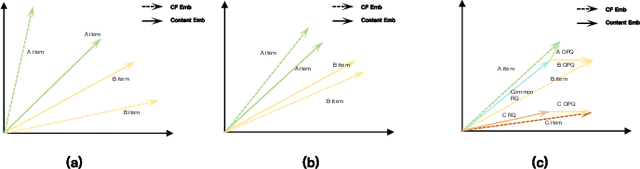
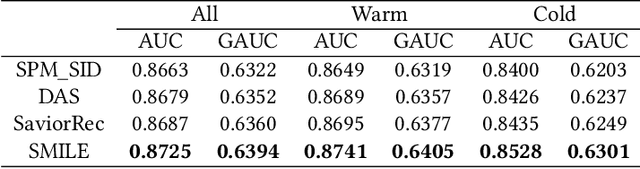
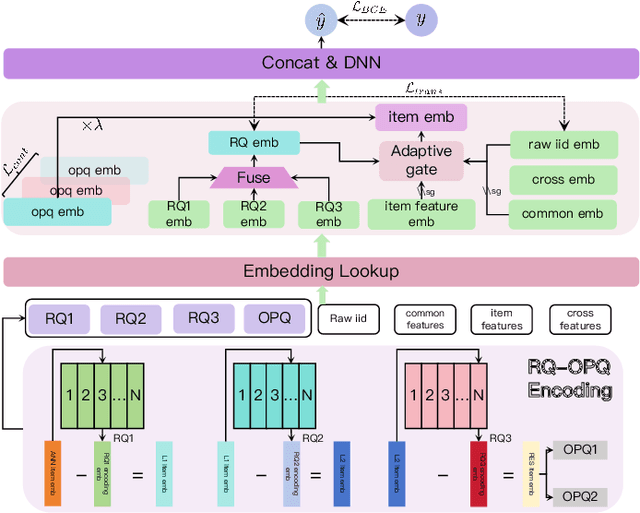
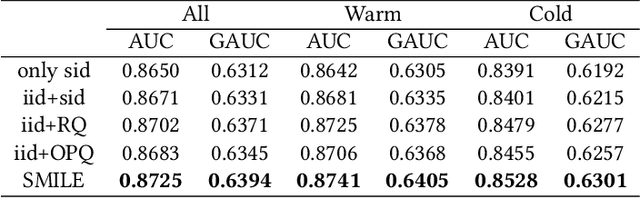
With the rise of modern search and recommendation platforms, insufficient collaborative information of cold-start items exacerbates the Matthew effect of existing platform items, challenging platform diversity and becoming a longstanding issue. Existing methods align items' side content with collaborative information to transfer collaborative signals from high-popularity items to cold-start items. However, these methods fail to account for the asymmetry between collaboration and content, nor the fine-grained differences among items. To address these issues, we propose SMILE, an item representation enhancement approach based on fused alignment of semantic IDs. Specifically, we use RQ-OPQ encoding to quantize item content and collaborative information, followed by a two-step alignment: RQ encoding transfers shared collaborative signals across items, while OPQ encoding learns differentiated information of items. Comprehensive offline experiments on large-scale industrial datasets demonstrate superiority of SMILE, and rigorous online A/B tests confirm statistically significant improvements: item CTR +1.66%, buyers +1.57%, and order volume +2.17%.